Tampilkan postingan dengan label materi bahasa inggris. Tampilkan semua postingan

Kamis, 13 Februari 2020

Kata Sifat Bahasa Inggris untuk Mengungkapkan Perasaan

Kata Sifat Bahasa Inggris untuk Mengungkapkan Perasaan (Expressing Feeling)

Kata Sifat Bahasa Inggris untuk Mengungkapkan Perasaan (Expressing Feeling)

Banyak kata untuk mengungkapkan perasaan kamu menggunakan Bahasa Inggris. Kamu bisa menggunakan kata sifat bahasa inggris (adjectives) atau menambahkan linking verbs sebelum kata sifat.
Seperti: look, feel, seem, appear, smell, become, sound, get, taste, grow, dll.

Contoh:
Roses smell fragrant when they are fresh.
Every plant grows higher day by day.

Kata sifat digunakan untuk menunjukkan persaan, seperti happy, sad, angry, dll. Perhatikan kalimat-kalimat berikut.

The teacher is happy.
They are happy.
You look sad.
I am angry.
I am delighted
I am so excited

Adjectives dengan akhiran –ed dan –ing

Perhatikan kalimat-kalimat berikut:

  1. I was attracted by the title of the film.
  2. You said that waiting is boring.
  3. I was satisfied with the service because it is satisfying.
Kata sifat yang berakhiran –ed menunjukkan perasaan kita terhadap sesuatu, dan kata sifat yang  berakhiran –ing menunjukkan bahwa sesuatu menyebabkan atau memengaruhi kita dengan cara tertentu.
Kita perhatikan kalimat no. 3

I was satisfied with the service=I feel satisfied because of the service
Kedua kalimat diatas sama-sama memiliki makna bahwa saya senang/ merasa senang dengan/karena servisnya.

it is satisfying=The service is satisfying
The service causes me satisfied. (Pelayanannya membuat saya senang).

Berikut beberapa contoh kata sifat dengan akhiran ed dan ing.

  1. satisfied / satisfying
  2. embarrassed / embarrassing
  3. worried / worrying 
  4. excited / exciting 
  5. depressed / depressing .
  6. tired / tiring
  7. disappointed / disappointing 
  8. exhausted / exhausting.
  9. shocked / shocking.
  10. disgusted / disgusting.
  11. frightened / frightening
  12. excited / exciting
  13. amazed / amazing
  14. annoyed / annoying
  15. tired / tiring

Latihan:

Fill in the blanks with the following words: confident, satisfied, nervous, doubtful, optimistic, pessimistic.

1. I was _______ with the service.
2. I’m very _______ and ________ that I will fail in this interview.
3. Seeing a _______ man like him makes me down.
4. Anyway, feeling _______ won’t help us now. So, be _______ !
5. He is ________ in answering some the questions.


Jumat, 31 Januari 2020

Contoh dan Pengertian Recount Text

Recount Text - Pengertian, Contoh, Tujuan, Ciri, dan Generic Structure - Bisa Anda gunakan sebagai media belajar dan mengajar Bahasa Inggris - Developing English Competencies X - Materi Bahasa Inggris SMA kelas 10

Contoh Recount Teks 

Teks recount berikut saya beri judul "My Bad Day" yang dilengkapi dengan pertanyaan. Bisa Anda gunakan sebagai media belajar dan mengajar Bahasa Inggris. Isi teks recount berikut saya modifikasi dari teks "My Day" yang terdapat dalam Buku pelajaran Bahasa Inggris Developing English Competencies X. Buku tersebut mungkin masih digunakan oleh sebagaian sekolah sebagai Media Pembelajaran Bahasa Inggris SMA kelas 10.

My Bad Day
I had a bad day yesterday. First, I woke up one hour late and did not pray Shubuh in congregation at the mosque. It's because my smartphone's alarm didn't ring. Besides, I slept too late at that night. So, I was in such hurry that I didn't have time to have a breakfast. I got dressed so fast that I forgot to wear socks.
Next, I ran out of my house trying to get school in time. Unfortunately, I slipped into a ditch and made my shoes wet. Since I had no time to back home, I kept running to my school.
Finally, carrying wet shoes, I passed the school gate which was almost closed. Then, I asked permission from a teacher on duty for attending the class without shoes. After She heard my story, she granted. Then I put my shoes in the sun, right in front of my class, and went into the class right after. It was a terrible day. I hope I never have a day like the one I had yesterday.

Pertanyaan:

What happened to the writer yesterday?
Why did the writer wake up an hour late?
What did the writer do to get school in time?
Why did the writer's shoes get wet?
What did the writer do after passing the school gate?
What did the writer hope?

Pengertian

Recount text adalah jenis teks dalam Bahasa Inggris yang menceritakan suatu cerita, tindakan, atau kegiatan, yang biasanya, menceritakan pengalaman seseorang.

Tujuan

Teks Recount bertujuan untuk menghibur pembaca, sehingga tidak terdapat konflik dalam teks ini.

Ciri-Ciri

  1. Fokus pada individual seperti I dan We
  2. Menggunakan kalimat Past Tense (lampau) seperti: had, went, walked, entered, came, dll.
  3. Menggunakan kata yang menunjukan waktu dan tempat, seperti: After lunch, In the shed, dll.
  4. Menggunakan kata kerja yang menunjukan tindakan/ action verbs, seperti help, crutched, ran, dll.


Generic Structure

  1. Orientation: Menceritakan latar belakang informasi tentang siapa, di mana, kapan kejadian atau peristiwa terjadi. 
  2. Events: Menceritakan serangkaian peristiwa yang terjadi sesuai urutan kronologis. 
  3. Re-orientation: Merupakan penutup atau kesimpulan cerita. Untuk menutup suatu cerita, kita bisa memberikan opini kita mengenai cerita tersebut.

Minggu, 12 Januari 2020

Expressions for Greetings, Introductions, and Farewells

Expressions for Greetings, Introductions, and Farewells 

The dialogue below consists of Expressions for Introductions, Greetings, and Farewells, and can be used as a model in similar conversations.
Expressions for Introductions, Greetings, and Farewells - WELL BEING - Responses

A: Hello, I’m Ujang and I’m looking for a Library?
B: Hi, I’m Tole. You’re close; it’s just across the lawn. It’s the biggest building over there.
A: I see, well thanks a lot. You’ve been a big help.
B: My pleasure. Anyway, you’re a new transferred student, aren’t you?
A: Yes I am.
B: So how long have you been here, Ujang?
A: I’ve been here about two weeks. Well, what’s your major Tole?
B: I’m a Biochemistry student. What’s yours?
A: I’m not sure yet, but I’m kind of interested in Psychology. I'm sorry, I have to go. Thanks for your help. Maybe we’ll meet again sometime.
B: Could be, it’s a pretty small campus. Nice to meet you, Ujang. See you later.
A: So long.


GREETING AND FAREWELLS
Almost all conversations start with a greeting and end with farewells. There are several expressions; some formal and some informal. Which to use, of course, depends on the situation.

EXPRESSIONS

Hello, Hi, Good morning, Good afternoon, Good evening, What's up?, What's happening?, Goodbye, Bye, So long, Catch you later, I have to run, I have to be going now, I got to go now, So long, Later dude, Good day, See you again, I hope to see you again, See you later (soon), Call me

WELL BEING

Here are Some Expressions used in asking for someone’s well being to follow up the conversation:
How are you? How’s it going? How are things? How are things going? How have you been? How do you feel? How goes it? How are you doing? How's life treating you?

RESPONSES
IF GOOD (Great, Couldn’t be better, Fantastic, etc.).
IF SO-SO (Could be worse, I can’t complain, Not bad, etc.)
IF BAD (I’ve had better days, Not too good, Lousy, etc.)


INTRODUCTIONS
There are a number of standard expressions that can be used for introductions. Take a look at some of them.

EXPRESSIONS
1. A: Hello, I’m Mr. /Ms. …….
B: Hello, Mr. /Ms. …. I’m ….
2. A: My name is …….
B: Nice to meet you ….., I’m Mrs. ….
3. A: I’m ……….. What's your name?
B: My name is …..
A: It’s a pleasure to meet you Mr. Franks.
4. A: Allow me to introduce myself. My name is ………
B: I'm delighted to meet you …. My name is ……..


INTRODUCING OTHERS
On occasion, you may find yourself in a situation where you have to introduce one person to another. Look at these possible expressions that are used for this.

EXPRESSION

Ujang: Tole, I would like to introduce ....
Tole: Hello ......, nice to meet you.
........: Nice to meet you too, Tole.

Tole: Ujang, this is my friend Tally.
Ujang: Hi Tally, a pleasure to meet you.
Tally: Same here.

Tally: Ujang, let me introduce my supervisor, Mr. Jajang.
Ujang: it’s good to meet you Mr. Jajang
Mr. Jajang: Good to meet you too. But please, call me Jajang.


POINTS TO REMEMBER
• Many beginning learners use the expression “Nice to meet you” even when they interact with a person they have already been introduced to. This expression (Nice to meet you) is only used at a first meeting, not after that. Instead, if greeting a person for the second time, use “Nice to see you again”
• Bye Bye is an expression that very young children use when they are first beginning to learn to talk or on very rare occasions by women, but almost never by most adults.

Jumat, 20 Desember 2019

Materi Bahasa Inggris untuk Perhotelan

Materi Bahasa Inggris untuk Perhotelan

1. Contoh Dialog/ Conversation di Dunia Perhotelan

FRONT OFFICE_HOTEL
Receptionist : Red Hotel, Redy speaking. May I help you?
Caller : I’d like to reserve a room for two for next weekend.
Receptionist : Well, what kind of room would you like?
Caller : One on the beach side
Receptionist : Hm.., how about a double on the front?
Caller : That will be fine, but could you tell me how much the
rate, please.
Receptionist : The rate for that weekend is $100 dollars a night.
Caller : That's reasonable. Can I pay when I arrive?
Receptionist : Yes, but we do require a fifty dollar credit card
deposit to hold the room. You can cancel up to five
days in advance and we will
refund your deposit.
Caller : Great, I'll call you right back.
Receptionist : Okay, thank you for calling.

Contoh Dialog/ Conversation di Dunia Perhotelan, Contoh Ungkapan Bahasa Inggris di Lingkungan Perhotelan, Contoh Ungkapan Bahasa Inggris via Telepon

2. Contoh Ungkapan Bahasa Inggris di Lingkungan Perhotelan

Front Desk Receptionist
• Red Hotel, Redy speaking. How can I help you?
• What date are you looking for?
• How long will you be staying?
• How many adults will be in the room?
• I'm afraid we are booked that weekend.
• There are only a few vacancies left.
• We advise that you book in advance during peak season.
• Will two double beds be enough?
• Do you want a smoking or non-smoking room?
• The dining room is open from 4 pm until 10 pm.
• We have an indoor swimming pool and sauna.
• We serve a continental breakfast.
• Cable television is included, but the movie channel is extra.
• Take Exit 8 off the highway and you'll see us a few kilometers up on the left hand side.
• The rate I can give you is 99.54 with tax.
• We require a credit card number for a deposit.

3. Contoh Ungkapan Bahasa Inggris via Telepon

ANSWERING THE TELEPHONE CALL
• Hello (informal)
• This is the Red residence
• This is 02292559721

ASKING THE CALLER’S IDENTITY
• Who is speaking? (informal)
• Who is talking? (informal)
• Who is this? (informal)
• May I ask who’s calling?
• Who am I speaking to?

INTRODUCING YOURSELF
• This is Blue. (informal)
• Hello, this is Yellow Speaking. Informal)
• This is Orange calling (informal)
• This is Mr. Black calling for Mr. White
ASKING TO TALK TO SOMEONE
• Is Grey there, please? (informal)
• Is Purple in? (informal)
• Can I talk to Pink? (informal)
• May I speak with Mr. Green, please?

ASKING THE CALLER TO HOLD
• Just a second! (informal)
• Wait a minute! (informal)
• Hang on a second! (informal)
• Could you please hold?
• One moment, please!
• I’ll go get him.

LEAVING A MESSAGE
• Any messages? (informal)
• Do you want to leave a message?
• Would you like to leave a message?
• May I take a message?
• Can you tell Black, his friend Pink called, please?
• Can you let Brown know to call back at 02222222220?

CONFIRMING A MESSAGE
• Okay. (informal)
• I’ll make sure Brown gets your message.

ENDING A TELEPHONE CONVERSATION
• I’ve got to go. (informal)
• I better go now. Bye. (informal)
• I better get going. Talk to you later.(informal)
• Thank you for calling. Bye.
• Nice talking to you.
• Nice talking to you, too.

GRAMMAR REVIEW
The modal verbs yang sering digunakan dalam percakapan via telepon adalah: can, could, may, will, and would.
EContoh:
• Can I speak to your dad, please?
• Could you repeat your phone number, please?
• May I take a message?
• Will you please hold?
• Would you like to leave a message?

Rabu, 28 Januari 2015

Passive Voice in English

When to use passive voice

Passive voice is used when the focus is on the action

When to use passive voice

    • Use passive voice when you do not wish to emphasize the subject of the sentence. 
    • Also use passive voice when you wish to emphasize what happened and the person or thing acting is unknown or unimportant.  

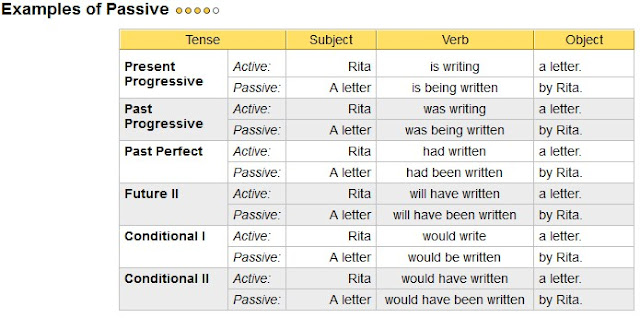
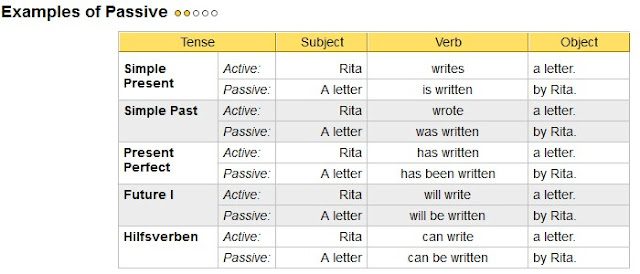
In a passive clause, we usually use a phrase
beginning with by if we want to mention the agent–the person or thing that does the action, or that causes what happens.
• Water is also released into the atmosphere by plants through photosynthesis.

We normally make passive forms of a verb by using tenses of the auxiliary be followed by the past participle (=pp) of the verb. Here is a list of all the passive forms of an ordinary English verb, with their names.


Minggu, 26 Oktober 2014

Jurus Jitu Menguasai Irregular Verbs


Cara membedakan irregular verbs salah satunya dengan mengamati keunikan yang ada dalam kelompok kata. Dengan memahami perbedaan dan keunikan yang dikelompokkan, saya optimis kamu bisa menguasai irregular verbs dengan mudah. Menguasai irrefular verbs bisa dengan cara menghafalnya. Memang, cara tersebut terkesan kuno dan trik jadul. Tapi, berdasarkan pengalaman saya, menghafalkan kosa kata Bahasa Inggris cukup membantu saya dalam mempelajari Bahasa Inggris.
Caranya, dengan menghafal minimal 5 kata per hari disertai dengan menerapkannya dalam bentuk kalimat acak. Selama menghafal kosa kata Bahasa Inggris, saya menuliskan kalimat dan melakukan monolog dengan kosa kata tersebut. Dalam menulis kalimat menggunakan Bahasa Inggris, mungkin kita bisa berfikir terlebih dahulu, kalimat apa, dengan kata apa, tenses nya mau yang mana, dlsb. Sehingga, dari segi hasil mungkin bisa lebih baik dan bisa terhindar dari kesalahan. Meski terkadang, karena banyak mikir, kalimat yang dihasilkan jadi sedikit. Tapi, dengan monolog, kita dituntut untuk secara spontan menerapkan kata yang sedang kita hafalkan dalam kalimat yang terlintas dalam ingatan kita. Misalnya, saat kita sedang bercermin, kita mengatakan "I won't let you go" "what are you doing?" "I am sleeping" "I slept last night" "i didn't sleep last night" dan seterusnya, sampai kita merasa sudah cukup.   

Jika Anda sedang belajar Bahasa Inggris, berikut saya cantumkan beberapa daftar Irregular Verbs beserta keunikannya.


simple form
past
past participle
Arti
1
bet
bet
bet
bertaruh
2
let
let
let
membiarkan
3
set
set
set
menyetel, terbenam
4
cut
cut
cut
memotong
5
shut
shut
shut
menutup
6
cost
cost
cost
berharga/ harganya
7
put
put
put
meletakkan
8
hurt
hurt
hurt
melukai
9
hit
hit
hit
memukul
10
quit
quit
quit
berhenti


11
dig
dug
dug
menggali
12
spin
spun
spun
memutar
13
stick
stuck
stuck
memukul
14
sting
stung
stung
menyengat
15
hang (up)
hung
hung
Menggantung (benda)
16
win
won
won
menang
17
shine
shone
shone
bersinar
18
hold
held
held
menggenggam
19
make
made
made
membuat
20
sit
sat
sat
duduk


21
feed
fed
fed
menyuapi/ memberi makan
22
lead
led
led
memimpin
23
meet
met
met
bertemu
24
bleed
bled
bled
berdarah
25
slide
slid
slid
meluncur


26
keep
kept
kept
menjaga
27
feel
felt
felt
merasakan
28
leave
left
left
meninggalkan
29
sleep
slept
slept
tidur
30
sweep
swept
swept
menyapu
31
build
built
built
membangun
32
bend
bent
bent
membengkokan
33
lend
lent
lent
meminjamkan
34
mean
meant
meant
bermaksud
35
spend
spent
spent
menghabiskan
36
send
sent
sent
mengirim


37
find
found
found
menemukan
38
wind
wound
wound
melilit
39
read
read
read
membaca
40
Have/has
had
had
memiliki
41
hear
heard
heard
mendengar
42
pay
paid
paid
membayar
43
say
said
said
berkata
44
sell
sold
sold
menjual


45
fight
fought
fought
berkelahi
46
bring
brought
brought
membawa
47
buy
bought
bought
membeli
48
catch
caught
caught
menangkap
49
teach
taught
taught
mengajar
50
think
thought
thought
berpikir


51
light
lit
lit
menyalakan
52
lose
lost
lost
kehilangan, kalah
53
shoot
shot
shot
menembak
54
tell
told
told
memberitahukan
55
stand
stood
stood
berdiri
56
understand
understood
understood
mengerti


57
become
became
become
menjadi
58
come
came
come
datang
59
run
ran
run
berlari


60
beat
beat
beaten
memukul
61
eat
ate
eaten
makan
62
bite
bit
bitten
mengigit
63
get
got
Gotten/got
memperoleh
64
fall
fell
fallen
jatuh
65
give
gave
given
memberi
66
go
went
gone
pergi
67
hide
hid
hidden
bersembunyi/ menyembunyikan
68
do/does
did
done
melakukan
69
see
saw
seen
melihat


70
break
broke
broken
memecahkan
71
choose
chose
chosen
memilih
72
drive
drove
driven
mengendarai
73
forget
forgot
forgotten
lupa
74
freeze
froze
frozen
membeku
75
ride
rode
ridden
naik/menunggang
76
rise
rose
risen
naik


77
shake
shook
shaken
menggoncangkan
78
speak
spoke
spoken
berbicara
79
steal
stole
stolen
mencuri
80
swear
swore
sworn
berjanji
81
take
took
taken
mengambil
82
wake
woke
woken
bangun
83
wear
wore
worn
memakai/ mengenakan
84
write
wrote
written
menulis
85
forgive
forgave
forgiven
memaafkan


86
blow
blew
blown
bertiup
87
draw
drew
drawn
menggambar
88
fly
flew
flown
terbang
89
know
knew
known
tahu/ mengetahui
90
throw
threw
thrown
melempar


91
begin
began
begun
memulai
92
drink
drank
drunk
minum
93
ring
rang
rung
berbunyi/membunyikan
94
shrink
shrank
shrunk
menyusut
95
sing
sang
sung
bernyanyi
96
sink
sank
sunk
tenggelam/ menenggelamkan
97
swim
swam
swum
berenang

Jika ada cara lain dalam menguasai dan mempelajari Irregular Verbs Bahasa Inggris, dan ingin kamu bagi disini, silahkan tulis di kolom komentar.

Banking Expressions in English

Banking vocabulary • Automatic deposit- A bank service that allows employers to deposit employees wages directly into the employees bank acc...